| Composition |
One dose contains:
Active substance:
Escherichia coli, live, without the aroA gene, 5.2 x 10⁶ - 9.1 x 10⁸ CFU* serotype O78, strain EC34195.
Colony-forming units after cultivation on soy trypticase agar plates.
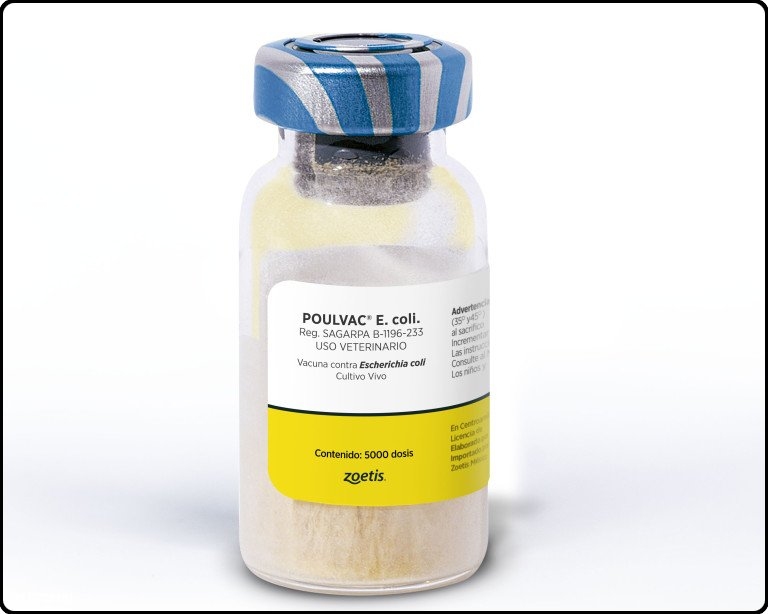
Lyophilized, cream color.
After reconstitution, an opaque suspension, transparent to pale yellowish (depending on the volume of diluent used).
|
| Indications |
For the active immunization of broiler chickens, future laying hens/breeder hens, and turkeys, to reduce mortality and lesions (pericarditis, perihepatitis, airsacculitis) associated with Escherichia coli, serotype O78.
Onset of immunity:
- Chickens: 2 weeks after administration for reducing lesions. Onset of immunity for mortality has not been established.
- Turkeys: 3 weeks after the second vaccination for reducing lesions and mortality.
Duration of immunity:
- Chickens: 8 weeks for reducing lesions and 12 weeks for reducing mortality (aerosols). 12 weeks for reducing both lesions and mortality (drinking water).
- Turkeys: Duration of immunity has not been established.
A cross-protection study showed a reduction in the incidence and severity of airsacculitis caused by E. coli, serotypes O1, O2, and O18, when administered via aerosols for chickens. For these serotypes, the onset or duration of immunity has not been established.
|
| Dosage and method of administration |
Administration via large particle aerosol for chickens/turkeys or in drinking water for chickens.
After reconstitution, an opaque suspension, transparent to pale yellowish (depending on the volume of diluent used).
Vaccination schedule:
Chickens: Administer via large particle aerosol starting at 1 day old or administer 1 dose via drinking water starting at 5 days old.
Turkeys: Administer via large particle aerosol starting at 1 day old, followed by a second vaccination 3 weeks later.
Administration:
Aerosol administration:
Use clean vaccination materials and close the ventilation for 15 minutes after vaccination.
Remove the seal cap and stopper. Fill the vial halfway with non-chlorinated water at room temperature. Reattach the stopper and shake well until dissolved. Pour the reconstituted vaccine into a clean container and add non-chlorinated water to further dilute the vaccine for uniform distribution when applied via aerosol to the birds.
Do not use disinfectant sprayers or other substances that could impair the performance of the live vaccine.
Dilute and administer the reconstituted vaccine at a rate of one dose per bird, according to the specific instructions for the large particle aerosol equipment. The recommended volume for 1 dose is between 0.1 and 0.5 ml. The spraying distance should be between 30 and 80 cm above the animals to ensure uniform distribution, with a recommended droplet size of greater than 100 µm.
Use in drinking water:
Ensure that all pipes, troughs, etc., are perfectly clean, with no traces of disinfectants, detergents, soap, etc., or antibiotics. Contact with disinfectants renders the vaccine ineffective.
Before vaccination, allow the water to be consumed until the levels in the drinkers become minimal. All pipes should be emptied of plain water so that the drinkers contain only water with the vaccine.
It may be necessary to withhold water before vaccination to ensure that the birds drink water during vaccination.
Open the vaccine vial under water and dissolve it well in a container. Ensure the vial and cap are completely emptied by rinsing with water. Do not divide large vials for vaccinating more than one poultry house or one drinking system, as mixing errors may occur.
Use cold, fresh, non-chlorinated water free of metallic ions. It is possible to add skimmed milk powder (e.g., <1% fat) (2-4 grams per liter) or buttermilk (20-40 ml/liter of water) to improve water quality and enhance bacterial stability.
Ideally, the vaccine should be diluted in an amount of water that will be consumed by the birds within 3 hours. The goal is for each bird to receive one dose of the vaccine. As a general rule, administer the vaccine in fresh, non-chlorinated water at a rate of 1000 vaccine doses per 1 liter of water for each day of age for 1000 chicks, e.g., 10 liters of water for 1000 chicks at 10 days old. If in doubt, water consumption should be measured 1 day before vaccination.
|
| Release form |
10 ml borosilicate glass vial type I for 2500 and 5000 doses, and 50 ml for 10000 and 20000 doses, sealed with a chlorobutyl rubber stopper and aluminum cap.
Cardboard box with one vial of 2500, 5000, 10000, or 20000 doses.
Cardboard box with ten vials of 2500, 5000, 10000, or 20000 doses.
*Not all packaging sizes may be marketed.
|