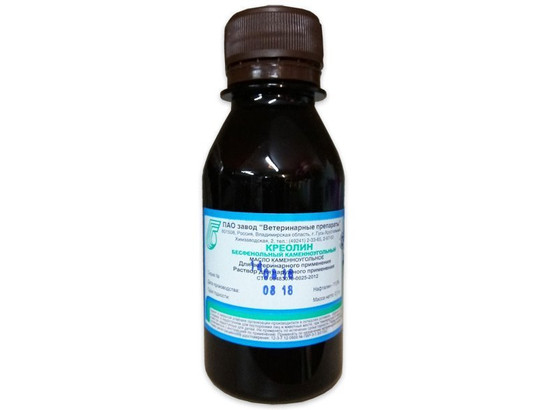
Home Catalog Creolin

Creolin

Species Cattle, sheep, goats (also used as a disinfecting substance).
Composition

One ml of the product contains:

Active substance:
Naphthalene – 115 mg

Excipients:

  • Colophony
  • Sodium ichthyol
  • Neonol
  • Water (up to 1 ml).
Indications

Creolin without coal-tar phenols exhibits acaricidal action against Psoroptes equi (ovis variety) in goats and sheep, having a long-lasting residual effect on the fleece and skin.

It possesses antimicrobial activity against:

  • Gram-positive and Gram-negative bacteria, including the pathogenic agents responsible for:
  • Bovine necrobacillosis (Fusobacterium necrophorum);
  • Infectious footrot in sheep (Dichelobacter nodosus);
  • Fungi from the Candida family.


It is also recommended for disinfection of:
Surfaces in industrial halls and auxiliary rooms;
Vehicles used for transporting animals.

Dosage and method of administration

Treatment of psoroptic mange in sheep and goats

Conditions: In dry weather, at an air temperature above 20°C; in the cold season, in heated facilities.
Method: Bathing in a 2% emulsion (2 kg Creolin without coal-tar phenols / 100 l water or 20 kg / 1000 l water) with head immersion.
Emulsion temperature: Minimum 20°C.
Exposure time: 2 minutes.

Frequency:

  • Curative: Twice, with a 10-day interval.
  • Preventive: Once.

Preparation of animals:

  • Allow animals to rest and stop feeding 4–5 hours before the procedure.

Preparation of the solution:

Mix Creolin without phenols thoroughly in the required amount of water shortly before use.
Bath refilling: After bathing 200 sheep, add product to maintain a 2% concentration.

Post-treatment:

Keep animals for 15 minutes in a designated area for draining the emulsion, then move them to pasture.
During the cold season, allow them to dry indoors.
Bath maintenance: If the emulsion becomes contaminated, empty the bath, clean it, and refill it. Residues are drained into a concrete-walled reservoir to prevent environmental pollution.
Preliminary testing: Before mass treatment, test on 10–15 animals; if no signs of intoxication appear within 2 days, treat the entire stock.

Prevention of infectious footrot in sheep and goats and necrobacillosis in cattle

  • Method: Healthy animals are passed through a disinfectant bath containing a 3% emulsion (3 kg Creolin without phenols / 100 l water).
  • Frequency: Twice, with a 10–15-day interval.
  • Contact time: 2–3 minutes.
  • Bath depth: Minimum 15 cm to immerse the limb.
  • Conditions: Outdoors (warm season) or indoors (cold season).
  • Maximum effectiveness: In affected farms, combine with vaccination and other sanitary-veterinary measures.

Surface disinfection

Preventive:

  •  Emulsion: 3% (3 kg / 100 l water).
  •  Application rate: 0.5 l/m².
  •  Exposure time: 3 hours.
  •  Surfaces: Industrial halls, auxiliary rooms, rabbit sheds, storage rooms, feed rooms, vaccination areas, skinning rooms, vehicles and wagons (metal).

For current need (against *E. coli* and staphylococci):

  •   Emulsion: 3.5% (3.5 kg / 100 l water).
  •   Application rate: 0.5 l/m².
  •   Exposure time: 3 hours.

Method: Spraying with equipment (DUK-1, DUK-2, AVD-1, UDP-M, LSD-3M, LSD-EP) in the absence of animals and food or slaughter products.
Preparation: Mechanical and hydromechanical cleaning of surfaces to remove organic impurities that reduce effectiveness.
After disinfection:

Rinse feeders, drinkers, sheds, and surfaces accessible to animals or products with plenty of water.
 Air the rooms (open windows, doors, ventilation on) until the specific smell disappears.

Recommendations for correct administration

Bath maintenance: If the emulsion becomes dirty, empty the bath, clean it, and refill it. Residues are stored in concrete reservoirs to prevent environmental pollution.
Preliminary testing: Each batch is tested on 10–15 animals; if no signs of intoxication appear within 2 days, treat the entire herd.

Contraindications

Increased individual sensitivity of the animal to the components of the product.
Processing is prohibited for:

  • Lactating animals;
  • Animals suffering from infectious diseases;
  • Weak or cachectic animals.
Waiting period - Slaughter of animals for human consumption is permitted no earlier than 24 hours after the last treatment with Creolin without coal-tar phenols.
- Carcasses obtained before this period expires may be used for feeding fur-bearing animals or for the production of meat-and-bone meal.
Release form - Polymer bottles: 0.1 kg
- Polymer bottles: 0.5 kg and 1.0 kg
- Polymer canisters: 5 kg and 21.5 kg.
Storage conditions Store in a dark place, separate from food and feed, at T°C -25°C to
+ 40°C, out of reach of children.
Shelf life 5 years from date of manufacture, from first opening – according to the label in the original packaging.
Shelf life after dilution – 4 hours.
Do not use after the expiry date indicated on the packaging.