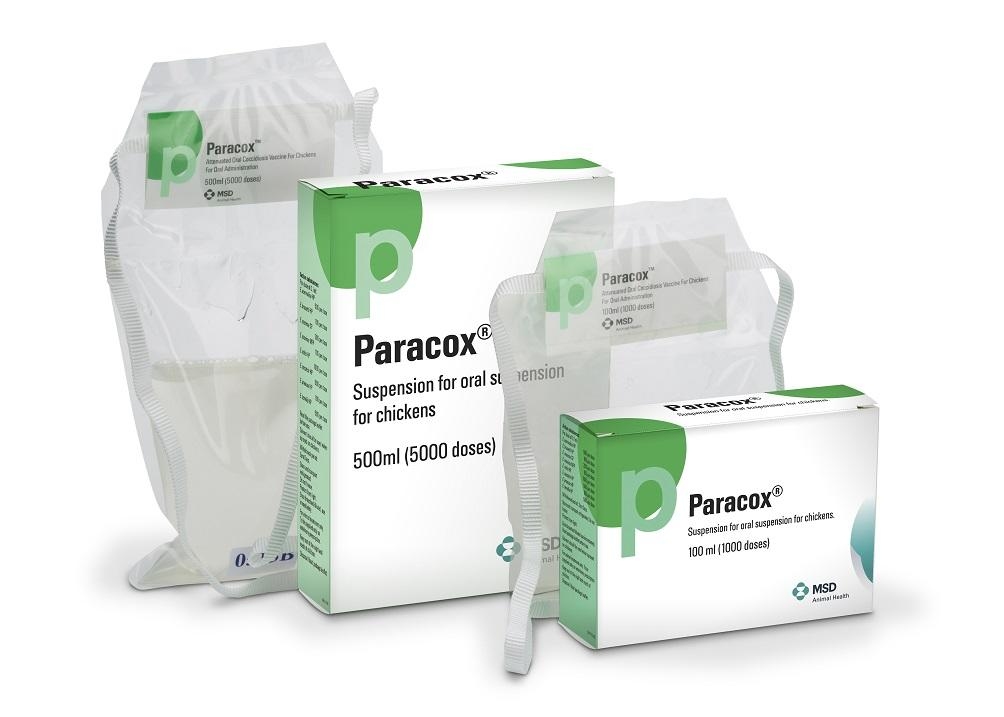
Home Catalog Vaccine Paracox

Vaccine Paracox

Species Chicks.
Composition

Each dose of 0.1 ml vaccine contains the following amounts of sporulated oocysts*

E. acervulina HP - 500 per dose
E. brunetti HP - 100 per dose
E. maximum CP - 200 per dose
E. maximum MFP - 100 per dose
E. mitis HP - 1000 per dose
E. necatrix HP - 500 per dose
E. praecox HP - 100 per dose
E. tenella HP - 500 per dose

* According to the manufacturer's in vitro counting procedure at the time of mixing and release.
Solvent for spraying on chicken
Carminic acid (red dye E l20)
Xanthan gum (E415)

Indications

For active immunization of chickens to reduce infection and clinical signs of coccidiosis caused by Eimeria acervulina, E. brunetti, E. maxima, E. mitis, E. necatrix, E. praecox, and E. tennela.
Spray on feed or administration in drinking water.

Installation of immunity:
begins to develop within 10 days post-vaccination Duration of immunity: at least 36 weeks post-vaccination if birds are kept in conditions that allow recirculation of oocysts.

Spraying the chickens
For the active immunization of chickens against coccidiosis caused by Eimeria acervulina, E. brunetti, E. maxima, E. mitis, E. necatrix, E. praecox, and E. temelia'.
- To reduce the excretion of oocysts for E. acervulina, E. brunetti, E. maxima, E. necatrix, E. praecox and E. tenella.
- To reduce bird weight loss for E. acervulina, E. brunetti, E. mitis, E. necatrix, E. praecox and E. tenella.

Installation of immunity: 21 days post-vaccination.
Duration of immunity: 10 weeks

Dosage and method of administration

a) Administration in drinking water

Drip irrigation pipes
The product can be administered in water through the watering lines from the first day of life of the chicks, provided that this procedure ensures the consumption of vaccine water, equally, in all chicks, avoiding sedimentation of oocysts. For example, the following methods have been shown to be effective: The vaccine must be diluted to a concentration of one dose / 2 ml of cold water and shaken very well before use. Calculate the total volume of water in the watering system to be used, the average number of birds per watering line, and the resulting number of watering lines and the volume of diluted vaccine required.
For static watering lines it is recommended that the birds are thirsty 1-2 hours before the vaccine is administered. Each line must be emptied and then filled by gravity with the vaccine solution before the birds have access to the drippers. An indicator (about 1 liter of milk) can be used initially to note when the solution has reached the end of the watering line, at which point it is closed to avoid vaccine wastage. When all the diluted vaccine has been consumed, watering will be done with the main water source.
For water lines temporarily connected to a recycling system, it is recommended that the diluted vaccine be temporarily stored in a tank built into the circulation system, ensuring that all contents remain well homogenized. For the purpose of uniform homogenization of the oocysts, the diluted vaccine should be allowed to recirculate in the watering lines for at least 2.5 hours before the birds are allowed access to the watering.
The above examples are intended as a guide to illustrate the principles to be followed in a specific drip irrigation system. Because of the difficulties associated with drinking water from droppers, special care should be taken to ensure that chicks 1-3 days of age drink enough water to ensure adequate vaccine consumption when this method of vaccination is used.
Alternatively, vaccination using additional drinkers is preferred at 5 - 9 days of age.
Occasionally, on farms using drip irrigation, additional lines will be used for the first 4-5 days. These can be fountain type sprinklers or small bell type sprinklers that are automatically fed from the drip line. If each additional watering can of this type is fed individually from a dripper, then the vaccination method is similar to that using bell watering cans. If, however, these waterers are fed sequentially from a single dripper, problems may arise due to air bubbles appearing after disconnecting the installation in order to achieve the 1-2 hour water diet required before vaccination. In this case it is better to make a preliminary initial dilution of the vaccine in a suitable container (eg a sprinkler) and pour the diluted vaccine into each watering can as in the case of individual fountain watering cans.

Adăpătorile automate circulare (tip clopot)

Paracox poate fi administrat în adăpători individuale. Este recomandat să se utilizeze un singur tip de adăpătoare la care păsările să fie obișnuite înainte de vaccinare. De aceea, această metodă nu este potrivită pentru puii de o zi.

Volumul optim de vaccin care se administrează în fiecare adăpătoare se calculează astfel;

No. total number of chickens / house (or pen) x 0.1 = Volume of vaccine / watering can
No. total followers / hall (or pen)

The vaccine is administered into each trough through a short 18-gauge cannula attached to an automatic syringe. A suitable cannula is included with each 100 or 500 ml bag. The syringe is directed obliquely with the surface of the water and moved around the waterer to ensure optimal distribution of the vaccine.

We need to make sure that the syringe is correctly calibrated.

Pick up the waterers 2 hours before vaccination. Make sure the waterers are clean and adjust the valve if necessary to ensure that the waterers contain the correct volume of water (250-400ml). Administer the required volume of vaccine into each trough as previously described. Lower the sprinklers immediately. The minimum volume of vaccine that should be administered is 10 ml/drinker and a maximum of 25 ml, when there are between 100 and 250 birds per drinker.

The water supply to the drinkers should not be interrupted during vaccination allowing the drinkers to refill automatically while the birds are drinking.

Watering lines with buckets, with gravity feed
Where linear drip feeders are equipped with gravity-fed cups, the vaccine is administered directly into each cup.
The method is similar to that used in the case of bell-type watering cans. The volume of vaccine is between 3 - 5 ml / watering can.

Gutter watering cans

The method is similar to that used in the case of bell-type watering cans. Empty and pick up the waterers two hours before vaccination. Make sure the waterers are clean. Allow the troughs to fill before administering the optimal volume of vaccine. As a recommendation regarding the number of waterers needed for vaccination, a watering space of 0.25-1 cm/bird must be ensured.

Tank type waterers (manually fed)

Remove the waterers 2 hours before vaccination. Make sure the waterers are clean. Fill the waterers with water and return them to the shelter before the optimal volume of vaccine is administered.

As a recommendation, the number of waterers required for vaccination should ensure approximately 0.25-1 cm of waterer space/bird.

IMPORTANT
The dilution of the vaccine will not be more than 1/50. The vaccine should not be administered in the main tank of the watering system. The dilution will be too high and the oochists will not stay in suspension.

b) On feed
A quick and uniform application method will be chosen over the entire surface of the feed to which the chickens have access.
The vaccine can be sprayed as is or diluted in water. If the vaccine is diluted, no more than 4 volumes of water will be added to one volume of vaccine (5000 doses of Paracox are added to 2 liters of water).
Care will be taken to agitate the tank applicator regularly throughout spraying to avoid depositing oocysts.

c) Spraying day-old chicks
The vaccine is distributed using a dose of 0.21 ml diluted vaccine per bird, by spraying. Determine the capacity of the tank of the vaccination room under the conditions of a volume distributed over 100 birds. Multiply this volume by 50 to give the volume of diluted vaccine required for 5000 doses (or by 10 for 1000 doses). For example. for the preparation of 5,000 doses of diluted vaccine, a total of 0.21 x 5,000 = 1,050 ml of diluted vaccine is required, divided in the form of vaccine, solvent and water according to the example below: 1,500 ml of Paracox vaccine (1 bag) 2,500 ml of solvent (1 bottle) 3. Add water up to 1050 ml
The solvent contains red coloring agent and xanthan gum both ensuring better ingestion.
The water used for dilution must be cold, fresh and unpolluted. Use a clean container to prepare the vaccine, add the solvent after the calculated amount of water and mix until you get a uniform solution. It is necessary to shake and squeeze the bag of 5000 doses (1000 doses) of Paracox for 30 seconds before use to ensure homogenization of the oocyst suspension. Add the entire contents of the bag to the solvent and water container and mix well.
Add the diluted vaccine to the applicator reservoir, and spray evenly over the chicks using the large particle spray.


Make sure that the entire surface of the chicken box has been evenly and completely covered. Leave the birds in the box for at least 30 minutes in a bright area to allow the chicks to absorb the vaccine.

Bag Instructions

The entire surface of the plastic bags is flattened and they do not need a valve needle. The contents remain sterile and cannot be opened until the plastic tube is inserted into the plastic probe. The bag can be hung by the operator around the neck or on the belt.

Instructions for using the bag

Attach the tubing (included in each package) to the properly calibrated auto-syringe. Center the plastic probe (attached to the transfer tube) in the circular device at the base of the bag. Quickly and forcefully press the probe through the membrane of the device. The probe enters a safety position in the valve. A small amount of vaccine is added to each bag to allow priming of the syringe.

Contraindications Vaccination of clinically ill and/or weakened birds is prohibited.
Waiting period

Zero days.

Release form

Flexible plastic bags, nylon / polyethylene x 100 ml and 500 ml. Each bag has a safety clip and attachment strap. The bags are individually packed in cardboard boxes. Attached is a transparent sterile PVC tube for dispensing, an opaque polypropylene angled probe and fitted with a Boanta cannula.

Solvent for spraying on chicken
The solvent containers are PET bottles closed with a rubber stopper and sealed with an aluminum cap.
For administration by spraying on chickens, the vaccine is delivered together with the appropriate volume of solvent (100 ml for 1000 doses and 500 ml for 5000 doses).

Storage conditions

Keep out of sight and reach of children.
Paracox Store and transport in a refrigerator (2°C - 8°C).
Do not freeze.
To keep away from the light.

Chicken spray solvent
Store between 2°C - 25°C.

Shelf life

36 months from the date of production.

Do not use after the expiry date indicated on the packaging.