

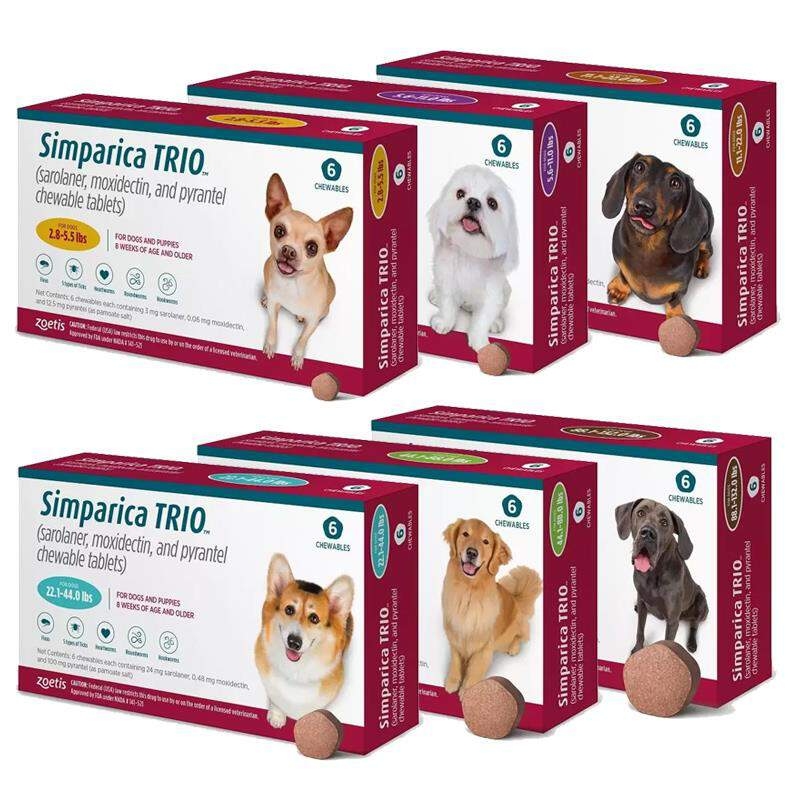

Simparica Trio
| Species | Dogs. |
|---|---|
| Composition |
Simparica Trio chewable tablets for dogs 1.25–2.5 kg Each tablet contains: For dogs 1.25–2.5 kg For dogs >2.5–5 kg For dogs >5–10 kg For dogs >10–20 kg For dogs >20–40 kg For dogs >40–60 kg |
| Indications |
For dogs with or at risk of infestation with external and internal parasites. The veterinary medicinal product is indicated exclusively when used at the same time against ticks, fleas and gastrointestinal nematodes. The veterinary medicinal product also has concurrent efficacy for the prevention of heartworm disease, angiostrongylosis and thelasiosis. Ectoparasites: For the treatment of tick infestations. The veterinary medicinal product has immediate and persistent tick-killing activity for 5 weeks against Ixodes hexagonus, Ixodes ricinus and Rhipicephalus sanguineus, and for 4 weeks against Dermacentor reticulatus; For the treatment of flea infestations (Ctenocephalides felis and Ctenocephalides canis). The veterinary medicinal product has immediate and persistent flea-killing activity against new infestations for 5 weeks; The veterinary medicinal product can be used as part of a treatment strategy to combat allergic flea dermatitis (FAD).For the treatment of sarcoptic mange (caused by Sarcoptes scabiei var.canis). For the treatment of demodicosis (caused by Demodex canis). Gastrointestinal nematodes: For the treatment of roundworm and hookworm infestations: Other nematodes: |
| Dosage and method of administration |
Oral administration. Dose: The veterinary medicinal product should be administered in a dose of 1.2-2.4 mg/kg of sarolaner, 0.024-0.048 mg/kg of moxidectin and 5-10 mg/kg of pyrantel according to the following scheme: Body weight: 1.25–2.5 kg Body weight: >2.5–5 kg Body weight: >5–10 kg Body weight: >10–20 kg Body weight: >20–40 kg Body weight: >40–60 kg Body weight: >60 kg Administration method: Treatment scheme: The treatment scheme must be based on the veterinary diagnosis, the local epidemiological situation and / or the epidemiological situation of other areas that the dog has visited or will visit. If it is based on the opinion of the veterinarian that re-administration(s) of the drug is necessary, any subsequent administration(s) must follow the schedule at a minimum interval of 1 month. The product should only be used in dogs when the treatment of tick / flea / and gastrointestinal nematode infestations is indicated at the same time. In the absence of risk of mixed co-infestation, a narrower-spectrum insecticide should be used. Treatment of flea or tick infestations and gastrointestinal nematodes: The veterinary medicinal product can be used as part of seasonal flea or tick treatment (replacing treatment with a mono-active flea or tick product) in dogs with diagnosed competing nematode infestations gastrointestinal. A single treatment is effective for the treatment of gastrointestinal nematodes. After treatment of nematode infestations, treatment for fleas or ticks should be continued with a mono-active product. Prevention of heartworm disease and angiostrongylosis: A single administration also prevents lungworm disease (by reducing immature adults (L5) of A. vasorum) and heartworm disease (D. immitis) for one month. If the product replaces another lungworm or heartworm prevention product, the first dose of the drug should be administered within one month of the last dose of the former veterinary medicinal product. In endemic areas, dogs should receive preventive treatment against lungworm and/or heartworm at monthly intervals. It is recommended that heartworm prevention treatment should be continued until at least 1 month after the last mosquito exposure. Prevention of thelaziosis (infestation with the eye worm Thelazia callipaeda in adults): Monthly administration of the product prevents the establishment of infestation with the adult eye worm Thelazia callipaeda. Treatment of demodicosis (caused by Demodex canis): Administration of a single dose once a month for two consecutive months is effective and leads to a marked improvement in clinical signs. Treatment should be continued until skin scrapings are negative on at least two consecutive occasions, one month apart. Because demodicosis is a multifactorial disease, it is recommended that any underlying conditions be treated as well. Treatment of sarcoptic mange (caused by Sarcoptes scabiei var. canis): Administration of a single dose at monthly intervals for two consecutive months. Additional monthly product administrations may be required based on clinical assessment and skin scraping. |
| Contraindications | Do not use in animals with hypersensitivity to the active substances or any of the excipients. |
| Waiting period | Not applicable. |
| Release form | 3 tablets in a dose corresponding to the weight of the dog. |
| Storage conditions | Store in a dark place, separate from food and feed products, at a temperature of 2°C +25°C, in places inaccessible to children. |
| Shelf life |
2 years from the date of production, from the first opening - 28 days. Do not use after the expiry date indicated on the packaging. |