|
Dose at least 6.0 log10 ELD50 per bird
- administration through aerosols (spraying).
- administration in drinking water.
- application of oculo / nasal drops.
Vaccination can be carried out from the age of 1 day. The volume required for administration depends on the method, the equipment used and the age of the vaccinated birds.
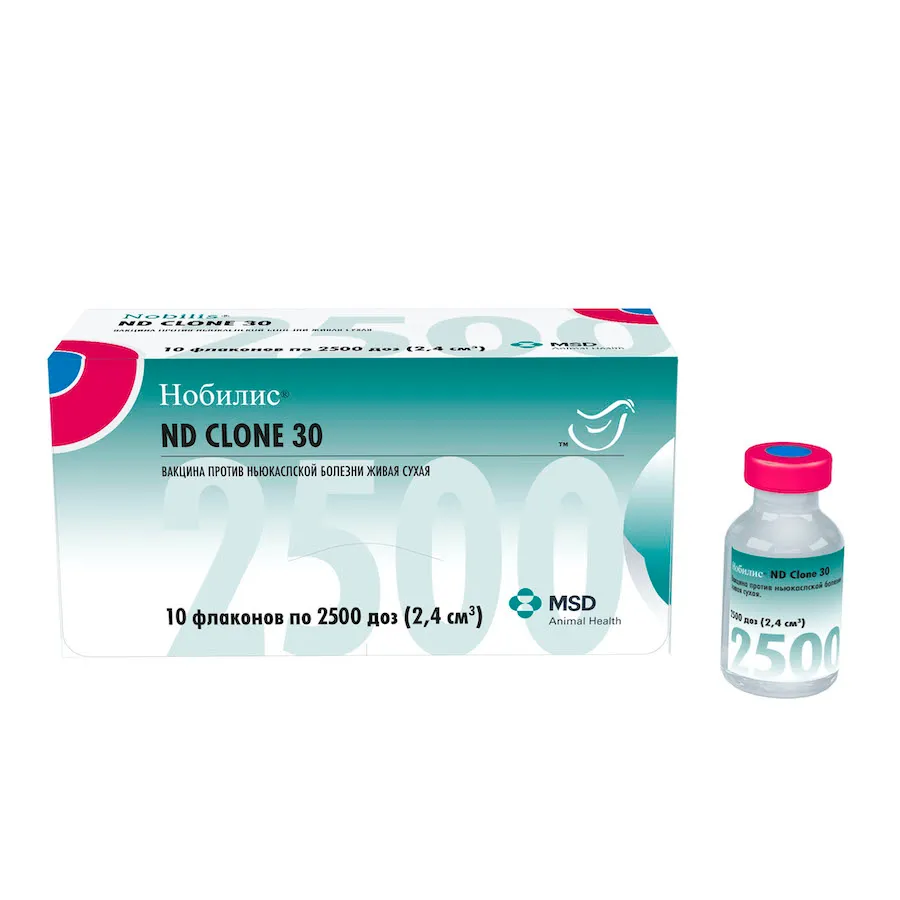
The vaccine comes in glass vials or plastic containers. For product presented in containers, do not use the product if the contents are brown and stuck to the container as this indicates that the integrity of the container has been breached.
The contents of the container must be used immediately and completely after opening.
Spray method (large particle)
Reconstitute the vaccine in cold, clean water to which 2% skim milk may be added. Chlorinated water is not used. Bottles or containers must be opened under water. Blend well before use. After reconstitution, the suspension is transparent. The water and the sprayer must not contain sediment, traces of corrosion or disinfectants (preferably to be used only for vaccinations). The volume of water for reconstitution differs according to age but should be sufficient to ensure an even spray over the correct number of birds from a distance of 30-40 cm, preferably when the birds are grouped and in semi-darkness. 250 to 500 ml of water per 1000 doses of vaccine is recommended. If applicable, reduce or stop ventilation to prevent loss of spray.
Oral method (with drinking water)
Reconstitute the vaccine in cold and clean water, to which you can add 2 g of skimmed milk/liters of water (to preserve the activity of the virus for a longer time). Chlorinated water is not used. Bottles or containers must be opened under water. Blend well before use. After reconstitution, the suspension is transparent. The vaccine suspension must be consumed within 2 hours. Depending on weather conditions or microclimate parameters, it may be advisable to restrict water before vaccination.
It is recommended to use a sufficient number of watering cans to ensure the proper watering front. They must be clean and free of traces of detergents and disinfectants. Dissolve 1000 doses in a number of liters of water equal to the age of the chickens in days, but no more than 40 liters.
The vaccine should be administered early in the morning, as this is the main time of water consumption or the cooler period on summer days. When vaccinating large animals, it is recommended to dissolve only a part of the vaccine at the beginning. Great care is taken when it is administered through the central water system (each bird receives the required dose). For the number of birds between the standard dosages, the next higher dosage will be chosen.
Intranasal / ocular administration
Reconstitute the vaccine with the required amount of diluent and administer with a standardized dropper (from which the droplet size is known). As a diluent, phosphate-buffered saline or distilled water can be used. The amount of diluent required for application by this method depends on the number of doses and droplet size, but approximately 35 ml/1000 doses. Administer a drop from a few centimeters into an eye or nostril. Make sure the nasal drop is inhaled by the bird.
Warning:
For intranasal/ocular administration, oculo-nasal diluent is available.
Observation:
Administration as a large particle spray or by the oculo/nasal route gives the best results. These should be the elective methods in case of vaccinating young birds.
Vaccination schedule:
Depending on the epidemiological situation, it is recommended:
a) In areas with an increased risk of infection with the Newcastle disease virus:
- the first aerosol vaccination, at the age of one day;
- the second aerosol vaccination, at the age of 3-4 weeks.
b) In areas without risk of infection with the Newcastle disease virus:
- in areas where Mycoplasma infections develop:
- the first vaccination, by administration in drinking water or by nasal instillations, at the age of 2-3 weeks;
- the second vaccination by administration in drinking water, at the age of 7-8 weeks.
c) In areas with low risk of respiratory infections:
- vaccination by aerosols, at the age of 1-2 weeks. A single vaccination is sufficient for broiler chickens
|