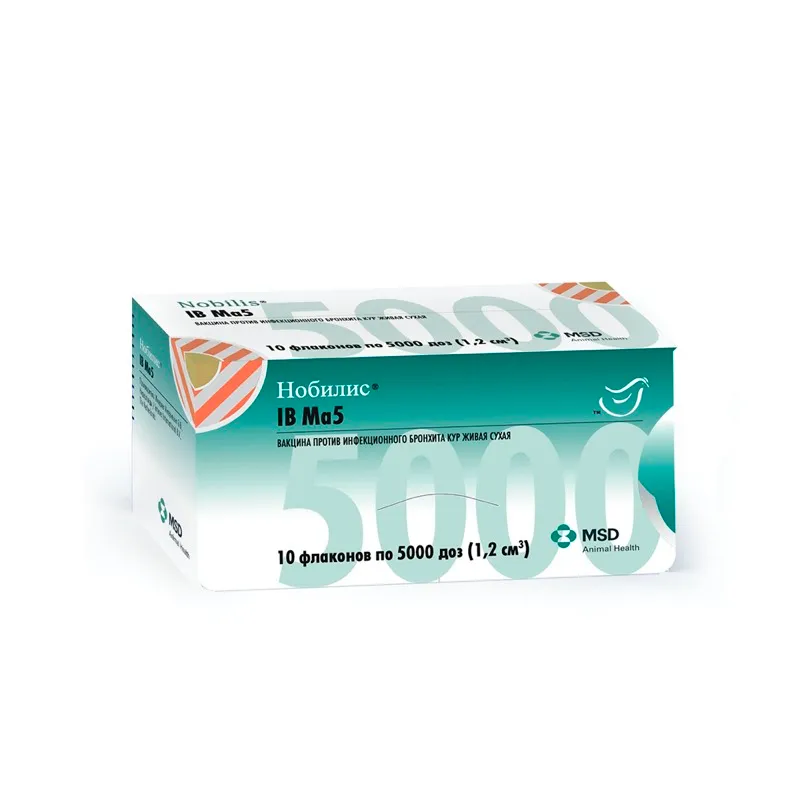
Home Catalog Vaccine Nobilis IB Ma5

Vaccine Nobilis IB Ma5

Species Chickens.
Composition Each vial contains, per dose, live infectious avian bronchitis virus, strain Ma5, serotype Massachusetts, minimum 3.0 log10 EID50, in stabilizer.
Stabilizer composition per ml (before lyophilization):
– sorbitol 66.6 mg,
– hydrolyzed gelatin 33.3 mg,
– pancreatic digest of casein 33.3 mg,
- disodium phosphate dihydrate 0.167 mg,
- water for injections up to 1.0 ml.
Indications Vaccination of chickens against infectious bronchitis. The vaccine can be used for both primary and booster vaccination.
Dosage and method of administration

A. The spray method.
The vaccine dissolves in cold, clean water without traces of iron or chlorine. The vials are opened under water.
The aerosol generator must be free of sediments, traces of corrosion or traces of disinfectant (it would be preferable for the device to be used only for vaccination). The water in which the vaccine has been dissolved must be sprayed evenly over the correct number of birds, from a distance of 30-40 cm, preferably when the birds are grouped in semi-darkness.
1-day-old chicks: use 0.25 liters of water per 1000 chicks, and adjust the nozzle to produce droplets that form a fine rain.
For older birds: dissolve 1000 doses per liter of water and adjust the nozzle to produce fine droplets (the atomizer will only be used when it is known to be safe for the birds).

B. Intranasal / intraocular instillation.
Dissolve the vaccine in saline (usually 30 ml per 1000 doses) and administer with a standardized dropper. One drop is administered, from a few centimeters high, into an eye or a nostril. The person administering the vaccine will ensure that the nasal drop is inhaled by each bird.
Note: For intranasal / intraocular administration, the oculo-nasal diluent is available.

C. Through drinking water.
The vials are opened under water. Use cold, clean water without traces of iron or chlorine. If 2 grams of skimmed milk powder are added per liter of water, the virus maintains its activity for a longer time. The water in which the vaccine was dissolved must be consumed within a maximum of 2 hours. Depending on weather conditions, it may be necessary to restrict water before vaccination. It is essential to use an adequate number of sprinklers to ensure the proper watering front.
Waterers must be clean and without traces of detergents and disinfectants. Dissolve 1000 doses in a number of liters of water equal to the age of the chicks in days, but not more than 40 liters.
The vaccine will be administered early in the morning, this being either the main period of water consumption, or the cooler period in summer days. When vaccinating large herds, it is recommended to dissolve only part of the vaccine at first. Special care should be taken when the vaccine is administered through the central water system or with a dispenser.
When the number of birds is between two standard dosages, the next higher dosage will be chosen.

Note: Administration in the form of a large particle spray or via the oculo/nasal route determines the best result. These should be the methods of choice, especially when vaccinating young birds. The vaccine can also be administered through drinking water. The vaccine must be dissolved in a quantity of water that will be consumed within 2 hours.

Vaccination schedule: The optimal time of vaccination and the method of administration depend to a large extent on local conditions. That is why the advice of the veterinarian will be sought.
The vaccine is safe starting from the first day of the chickens' life.
Indicative:

Broilers: vaccination on the first day of life, large particle spray or intranasal/intraocular.

Laying and breeding hens: vaccination on the first day of life, large particle spray or intranasal/intraocular Revaccination at approx. 6 weeks of life, by the spray method, intranasal/intraocular or through drinking water.

Immunity: After the first vaccination, adequate immunity is obtained against BI virus serotype Massachusetts, which lasts about 6 weeks, if the vaccine was administered correctly.

Contraindications There is none, when the instructions are followed.
Waiting period

Zero days.

Release form Glass vials containing the freeze-dried pellet. Each bottle contains 500, 1000, 2000, 2500, 3000, 5000 or 10000 doses.
Storage conditions Keep out of reach of children.
Store in a refrigerator (+2 °C to +8 °C).
Avoid freezing.
Protect from light.
Shelf life

2 years from the date of production, after reconstitution – 2 hours.

Do not use after the expiry date indicated on the packaging.